
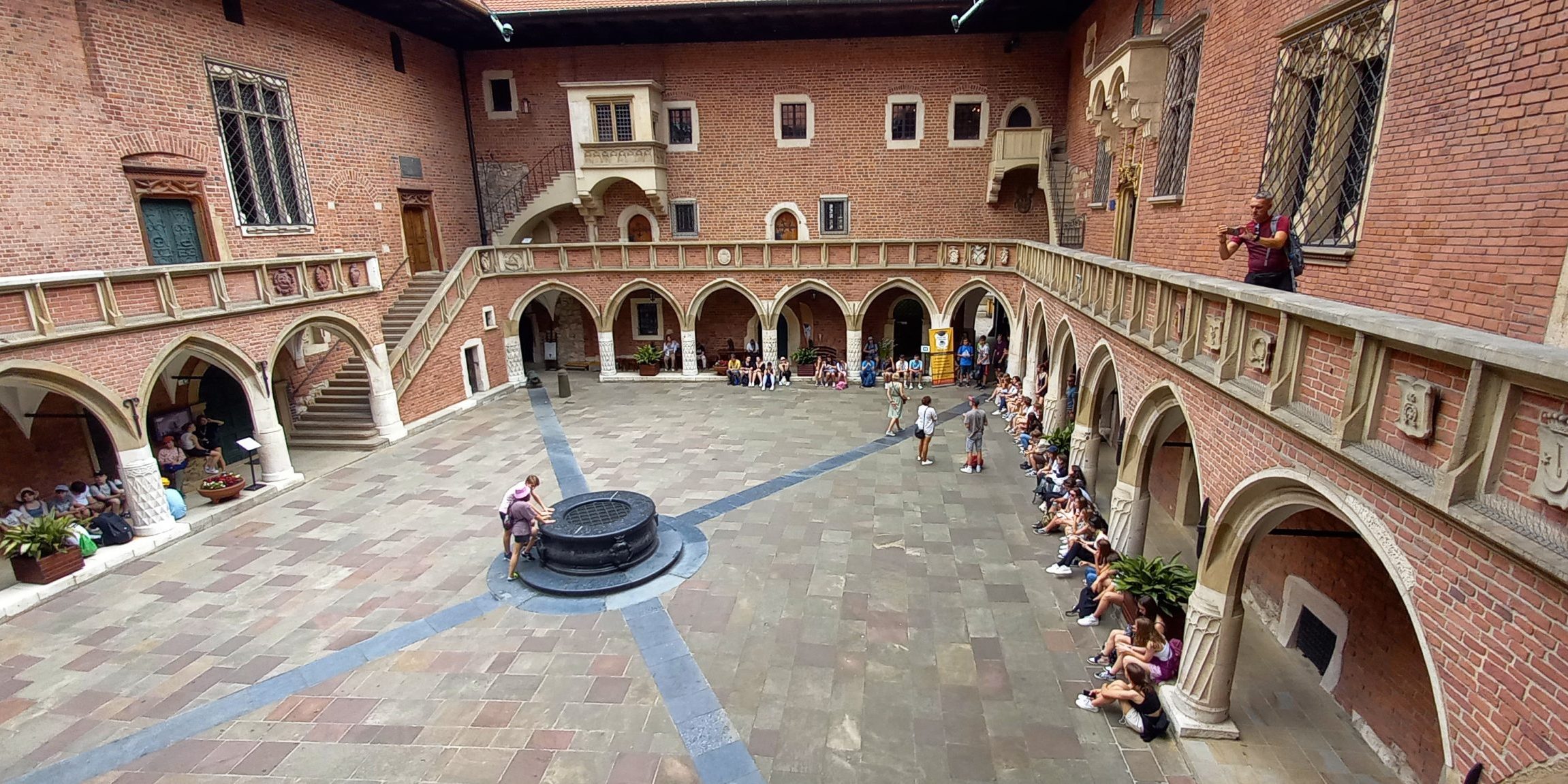
At the end of June, the second expedition as part of the «Cultural Journey of Francysk Skaryna» project concluded on the Vilnius-Krakow route, led by Professor Alexander Kalbaska, lecturer Sergey Charevsky, and researcher Alexey Lastovsky.
This unique Krakow-Lublin-Vilnius route was first traveled by Skaryna in the winter of 1504. After Krakow, where the pioneering printer studied at the renowned university and obtained a Bachelor of Arts degree in 1506, the researchers headed to the city of Poznan, which was also connected to the fate of the prominent Belarusian humanist and enlightener
During the expedition, participants monitored cultural and natural landscapes associated with Skaryna’s journey from Vilnius to Polotsk, studied objects of historical and cultural heritage from the Skaryna era (late 15th – early 16th century), and visited museums, libraries, and universities.
Additionally, meetings were held with renowned experts on the Skaryna era during the scientific journey, including Dr. Alexander Naumov, a professor at the Universities of Venice and Jagiellonian, Dr. Sergey Kovalev, a professor at the University of Lublin, Dr. Yuri Gordeev, an adjunct at the Institute of Eastern Europe of the Jagiellonian University in Krakow, and other researchers of Belarusian, Lithuanian, and Polish history and culture.
This time, the route consisted of a journey along the ancient Jagiellonian, or Royal Route. In 1386, to ascend to the royal throne in Krakow, the Grand Duke of Lithuania Jogaila embarked on a journey from Vilnius to Poland. When he arrived in Lublin, the knights gathered at the assembly elected him as the candidate for the crown, leading to his coronation and marriage to Queen Jadwiga in Krakow. This marked the beginning of the path that connected the capitals of the Kingdom of Poland and the Grand Duchy of Lithuania.
This route, Krakow-Lublin-Vilnius, not only witnessed royal processions multiple times but also served as a major trade route frequented by merchants, craftsmen, officials, diplomats, knights, priests, scholars, doctors, architects, and artists. When the Polish-Lithuanian Commonwealth was formed at the Lublin Sejm in 1569, the road from Vilnius, through Lublin to Krakow, became the most important route of the joint state. Its significance began to decline gradually only after the transfer of the capital to Warsaw in 1611 by Sigismund III Vasa.
The Jagiellonian Route acted as a true European cultural path, facilitating the exchange of ideas and achievements between the West (Latin civilization) and the East (Byzantine civilization), and played a significant role in the integration process of the Kingdom of Poland and the Grand Duchy of Lithuania.


